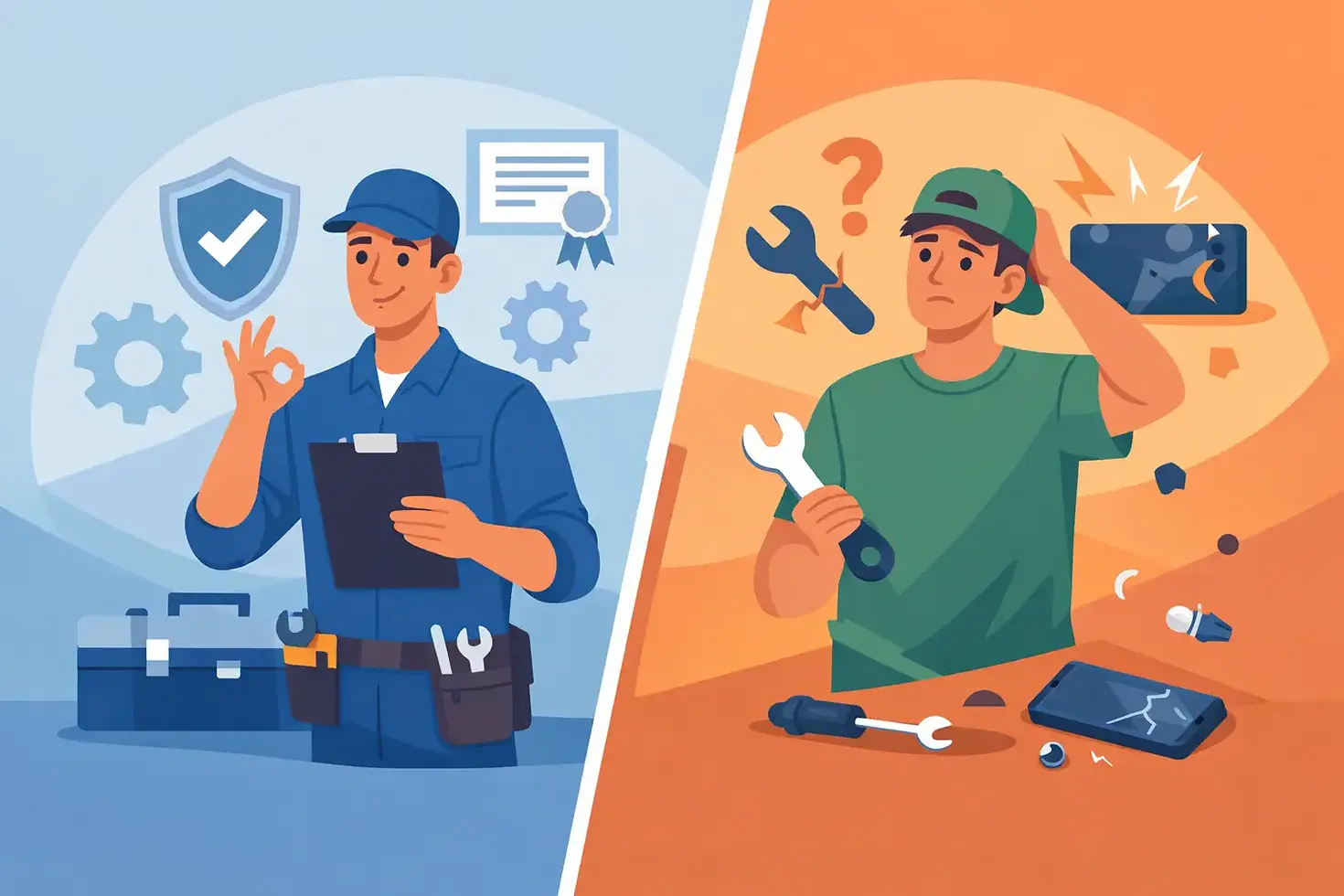
Licensed Versus Unlicensed Repair Technicians

When your fridge stops cooling or your washer starts leaking onto the floor, the decision usually feels urgent. In that moment, the difference between licensed versus unlicensed repair technicians is not just a checkbox - it affects safety, repair quality, warranty protection, and what happens if something goes wrong in your home.
Most homeowners are not trying to compare credentials for fun. They want the appliance fixed quickly, priced fairly, and handled by someone who knows exactly what they are doing. That is reasonable. But urgent service is also when people are most likely to book the first available name they find, without looking closely at whether that technician is properly licensed and insured.
Why licensed versus unlicensed repair technicians matters
Appliance repair happens inside your home, around the systems you rely on every day. A technician may be working with electrical components, gas connections, water lines, drainage systems, ventilation, or sealed refrigeration parts. A mistake can lead to more than an inconvenient callback. It can create property damage, food loss, fire risk, or a gas and electrical hazard.
That is why credentials matter. A licensed technician is operating within a professional framework. There is accountability, training, and usually insurance backing the work. An unlicensed technician may still claim experience, and some do have hands-on ability, but the homeowner often has no clear way to verify standards, coverage, or responsibility.
For a busy household in Vancouver, Surrey, Burnaby, Richmond, Langley, Delta, or Coquitlam, that difference shows up fast when the repair becomes more complicated than expected.
What a licensed repair technician usually brings
A licensed appliance repair technician is generally tied to a registered business structure and professional service standards. That does not mean every licensed company is equal, but it does mean the customer has stronger protections from the start.
The first advantage is accountability. If the technician diagnoses the problem incorrectly, damages the appliance, or causes an issue in the home, there is a business entity behind the work. That matters. You are not dealing with a cash-only transaction that disappears once the van leaves the driveway.
The second advantage is insurance. This is one of the biggest practical differences and one of the least understood by homeowners. If a technician causes water damage while repairing a dishwasher, or damages cabinetry while removing a built-in wall oven, insurance can become critical. Without it, the homeowner may be left sorting out a costly problem alone.
The third advantage is professionalism in process. Licensed service providers are more likely to give written estimates, documented labour, parts information, and repair warranty terms. That does not guarantee a perfect experience, but it gives you a clear record of what was promised and what was completed.
The appeal of unlicensed technicians
Unlicensed technicians are often chosen for one reason - price. They may advertise lower rates, immediate availability, or quick cash repairs with minimal paperwork. For someone dealing with an urgent dryer failure or a freezer full of thawing food, that can sound like a practical shortcut.
Sometimes the lower quote is real. Sometimes it is only lower at the start. A vague diagnosis, used parts with no warranty, or repeat visits can quickly erase the original savings. If the appliance fails again a few days later, the customer may have no recourse beyond another phone call that goes unanswered.
There is also a trust gap. A homeowner may hear, “I have been doing this for years,” but have no clear proof of training, business insurance, or service standards. Experience matters, but verified experience matters more when someone is opening up a gas range, rewiring a stove connection, or working on a high-end built-in refrigerator.
Where the real risks show up
The biggest risk with unlicensed repair is not always obvious on day one. In many cases, the appliance may seem to work after the visit. The problem shows up later.
A fridge that cools for two days and then warms up again. A washer that drains but leaves a hidden leak behind the machine. A dryer that runs, but now has a venting issue or electrical problem that was missed. These are the kinds of failures that turn a cheap repair into a more expensive one.
There is also the question of manufacturer guidance and parts quality. Some repairs require brand-specific procedures, calibration, or compatible replacement parts. A technician cutting corners on those details may get the unit running temporarily, but at the cost of long-term reliability.
For premium appliances, the margin for error gets even smaller. High-end brands often have more complex boards, sensors, sealed systems, and installation configurations. The technician does not just need confidence. They need current repair knowledge and the discipline to follow the proper process.
Licensed versus unlicensed repair technicians and home protection
For most homeowners, this is where the decision becomes clear. Your appliance is one asset. Your home is the larger one.
When you hire a properly licensed and insured repair company, you are reducing exposure. You are choosing a service model that is built to protect the customer as well as the appliance. That includes documented work, clear pricing, and a level of responsibility that is harder to avoid when a legitimate business is involved.
An unlicensed technician may complete the repair without issue. That does happen. But if there is a mistake, a part failure, or damage during service, the burden often shifts back to the homeowner. That is not a strong trade when the appliance in question is tied to water, power, heat, or gas.
How to tell if a repair company is the safer choice
The fastest way to assess a company is to look for a few signals before you book. Do they clearly state that they are licensed and insured? Do they explain their service process, warranty, and areas covered? Do they speak with confidence about the appliance type and the repair itself, rather than giving vague promises?
Good companies are usually direct. They tell you what they service, where they operate, how quickly they can respond, and what happens next. They do not avoid questions about credentials. They expect them.
It also helps to pay attention to how the booking conversation feels. A professional service team usually asks practical questions about the appliance brand, model, symptoms, and urgency. That level of detail often reflects how the repair will be handled on-site.
Speed still matters - but speed without standards is a gamble
Homeowners in the Lower Mainland often need same-day help. That is real life. A broken fridge cannot wait a week. A leaking washer cannot sit there until it becomes convenient. Fast response matters, especially for essential kitchen and laundry appliances.
But fast service should not mean lowering the bar on who enters your home. The strongest repair companies combine rapid response with proper licensing, insurance, and experienced technicians. That is the balance customers should be looking for.
A professional repair visit should feel efficient, not rushed. The technician should arrive prepared, explain the issue clearly, and complete the work with respect for your home. That is a very different experience from a quick fix that leaves you wondering whether the problem was actually solved.
When paying more is actually cheaper
There are times when a licensed repair company costs more up front than an unlicensed individual. That is true. But the better comparison is total cost, not initial price.
If the diagnosis is accurate the first time, the correct part is installed, the repair is documented, and the work is backed by warranty, the higher upfront cost may be the less expensive decision overall. You avoid repeat labour, added damage, wasted time, and the stress of starting over.
That matters even more during emergency repairs. When your oven fails before a family gathering or your freezer stops overnight, you need confidence in the repair, not just speed at the lowest number.
Companies such as FixCore Appliance Repairs build their service model around that expectation - rapid response, certified technicians, and licensed, insured work that gives homeowners a stronger sense of control when an essential appliance breaks down.
The better question to ask before booking
Instead of asking only, “Who can get here fastest?” ask, “Who can get here fast and do this properly?” That one change can save you from a second repair bill, a warranty dispute, or damage that never should have happened.
Licensed versus unlicensed repair technicians is not really a debate about paperwork. It is a decision about risk, accountability, and peace of mind. When a technician is working inside your home on equipment your household depends on every day, those things are worth paying attention to.
The best repair call is the one that solves the problem and lets you move on with your day, without second-guessing who you hired.


Comments